Filling Jobs Amid New Expectations
Printpack's top HR leader talks about the challenges with hiring today
Jamie Clark recalls predicting 10 years ago while presenting at a company meeting that the biggest constraint to the company’s growth eventually would be its ability to hire and retain workers.
“There were lots of people who looked at me like I had two heads,” says Clark, senior vice president and chief human resources officer (CHRO) at Printpack. “But it was not a hard prediction to make. You just saw it clearly in the historical birth rate demographics.”
As time passed, he adds, his prediction came true.
“And that is where we are today, primarily in the hourly workforce,” says Clark, who has been the top human resources (HR) executive at the Atlanta-based company for 12 years. “Recruiting people to work in our production facilities and then retaining them is the biggest people challenge we have.”
A Business Background
Originally from Canada, Clark attended a Canadian business school and began his career at a rigid and flexible packaging company before moving to the U.S., working for several companies before joining Printpack in 1996.
“I very much have a business mindset as to how I approach my role,” Clark says. “It is a commercial mindset of how to win in the marketplace: How do we innovate and grow? How do we position ourselves against our competitors to gain a competitive advantage?”
Clark has held various top positions at Printpack during his tenure, including director of sales and marketing, director of global operations, and vice president and general manager, before taking the CHRO role. He reports directly to CEO Jimmy Love.
Throughout his career, Clark has continually sought to learn and improve, taking courses at various leading business schools, including Harvard Business School’s General Management Program.
“My education in Canada was foundational to my early career, and the Harvard experience was foundational to the second half of my career,” he says. “I’ve always pursued learning opportunities. All of those experiences have helped shape my skill set and my worldview.”
His worldview, like that of all employees at Printpack, has been further shaped by Printpack founder and President J. Erskine Love Jr., who started the company in 1956—four decades before Clark became an employee.
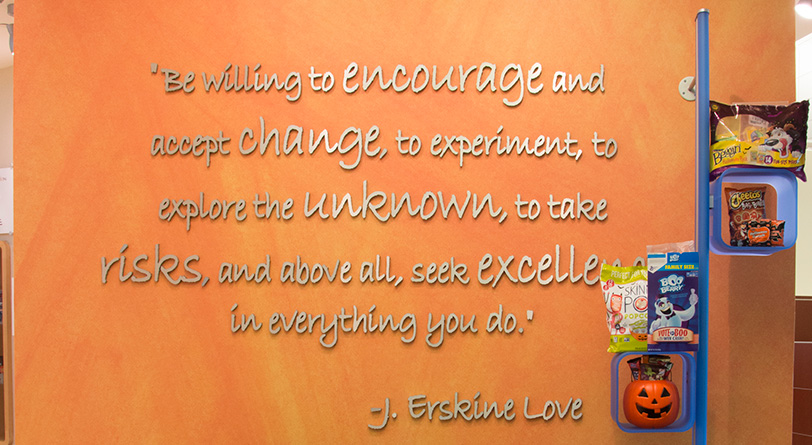
“Be willing to encourage and accept change, to experiment, to explore the unknown, to take risks, and above all, seek excellence in everything you do,” says a sign on a wall at the company. It is a quote from Love, who died in 1987.
Each employee always asks whether they are doing the right thing in line with Love’s business philosophies, Clark says.
“We are not perfect,” he adds, “but we do our best to live up to the ideals he set for us.”
Employees—or “associates,” as Printpack calls its workers—are at the top of the list of the company’s stakeholders. Like other manufacturers, Printpack continues to struggle with the demographic shifts Clark foresaw years ago. He is quick to point out that the company does not have all the solutions.
“Certainly, don’t write this like we have all the answers,” Clark said during a recent interview. “The struggle everyone faces is finding enough people to staff these factories with folks who want to work there, given that we have a significantly smaller labor pool today than we had 10 or 15 years ago.”
“It’s going to take creativity, and there is not one magic answer,” he added.
With his caveat in mind, Clark offers further insights into workforce trends, the future, and how Printpack is addressing its workforce concerns. His interview with FlexPack VOICE® is edited for clarity and length.
FlexPack VOICE®: As you say, hiring good workers has been an issue in numerous industries for years now. Talk a bit more about those trends.
Jamie Clark: From about the 1970s, two things have happened. Baby boomers entered the labor market in large numbers, and women began to participate more significantly in the workforce. We rode a wave for about 40 years where there were more people in the labor market than there was demand.
About 10 years ago, that started to change, driven by the advent of baby boomers starting to leave the workforce at a faster rate than new workers were coming in.
And back in the ’80s, there was the “tough guy” leadership model. That might have worked when you had lots of people and, if someone did not work out, you had someone else lined up at the door. That does not work well when you have no one lined up at the door.
We have a generation today with choices and expectations about what they want from their work. If they do not get that from their work, they will make a change. The power dynamic has completely changed, making HR more important over time.
FPV: You mentioned that the labor participation among men has fallen in recent years as well. Talk a bit about that.
JC: Within our plants, we are still predominantly a male industry, but the participation rate of men in the overall workforce has dropped about 5% from where it was in the ’70s and ’80s. We have increased the proportion of women working in our factories, but we still have more men than women. We have to figure out how we can attract more women. And that is where inclusivity comes in. How do we make sure everyone walking through the door feels welcome from day one, so they stay? We certainly want the good workers to stay.
FPV: How is the labor market different on the salary side versus in the factory?
JC: The salaried side, the professional side, is pretty stable right now, and we have low turnover in those ranks. On the hourly side, we have pretty low turnover once a worker has stayed with us for three years, but we see a lot of churn in the front end. We are laser-focused on how to address that because that dynamic is likely to exist for some time.
Going back to my commercial perspective, how do we win the labor market? We have two markets to think about. We compete within the communities where we operate, and we also compete in the broader flexible packaging market. If we are better at attracting and retaining good people, that becomes a competitive advantage.
Still, it is challenging to operate in that environment, particularly in manufacturing. Look at some of the numbers. In 2005, something like 23% of the population had a college education, meaning at least a bachelor’s degree. Today, that number is 36%, and many of those people did not go to college thinking they would work in a manufacturing plant.
FPV: To what do you attribute the lower turnover among the salaried workers and the factory workers who stick it out past their three-year mark?
JC: This is generally referred to as an “employee value proposition,” but at Printpack, we call it an “associate value proposition” because we call our employees “associates.”
We conducted research to determine what matters to the people who work at Printpack and what they want. And we asked, “What do we do well?” We looked at about 35 different attributes of why people join and stay with us. On everybody’s list, the most important component is compensation and benefits. Our benefits may be a little bit better than what you see in the manufacturing market, and our compensation is on target with the market.
We are going to win with other things. And those are a caring culture, ethical business practices, opportunities for career growth, and stability. We can deliver that because we are a private, family-owned business. It is harder for a manufacturer owned by private equity or a publicly traded company. We have a culture that cares. We provide opportunities for growth, and we generally promote from within.
And we do have high ethical standards here. We do not cut corners on ethics. The question that is always at the back of everybody’s mind here is “What is the right thing to do?” That provides us with a competitive advantage in the labor market.
FPV: Stability isn’t guaranteed, so what does that look like?
JC: While you cannot guarantee stability, this is a business where you are selling food packaging and medical packaging that, up until recently, has been pretty stable, and that provides people with a sense of security.
We are not immune to having to lay people off from time to time, but we do not just cut people off cold. We have severance based on your position level and years of service. We go into those events with a lot of dignity and respect. We are in the process of closing a plant this year. It is important that we buffer their transitions.
And when we terminate people, it is well-founded by the time we do so, and we do not do it easily. We will ask, “Is this the right thing?” and “Is there a different answer to solving this problem?”
It really goes back to Erskine Love’s founding philosophy. It is not lost on me that he put his employees, the associates, as the first stakeholder. He put our customers second, suppliers third, shareholders fourth, and the community. That philosophy is very much built into the business and how we operate.
FPV: Talk some more about that three-year mark that you mentioned with factory workers.
JC: There are a lot of things going on right now. The dynamics of the labor market are such that we are effectively hiring recent high school graduates to replace a tenured, skilled workforce who are retiring. This cohort has many more options than their parents’ generation.
They are at an experimental point in their lives. We have people coming in who do not have manufacturing experience. There is not a large pool of people to draw from, and we are bringing in people who find out this is not the work for them.
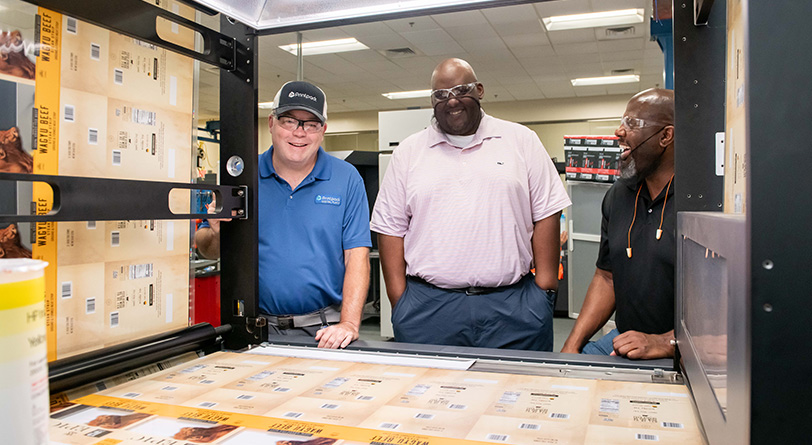
I have not heard any manufacturer say, “Boy, we have this cracked.” But once people get inside, the onboarding, training, and inclusivity become important. We realize that walking into one of our plants is a bit scary for a young person. The printing presses, the laminators, the extruders—they are all big, heavy pieces of equipment. It takes a bit of time to learn how to operate one of those machines.
We need to figure out how to better manage this phenomenon. For the ones who are not going to make it, we need to determine that early on. It is far worse if they quit after six months than if they depart after the first six weeks.
It comes down to workforce planning and how many people we need to hire to meet projected demand, recognizing that we must hire more than we think we need to. That is a hard mindset to change.
FPV: You mentioned the newer generations having different expectations.
JC: For example, people today want flexibility in their scheduling. It is tougher to provide that to our hourly workforce than to our salaried workforce, but there are ways of making it more flexible. We need to think about how we can do that.
The core element of that is leadership that delivers the value proposition. We need to make sure we have well-trained leaders schooled in how to lead today.
FPV: Are there initiatives that have worked well, especially when it comes to hiring for the plant floor, such as looking toward high schools and community colleges?
JC: It is somewhat dependent on the plant location. We have centralized the talent acquisition function. Before, it was not a big challenge for an HR group in a plant to manage the hiring. Today, we have talent acquisition specialists handling all of the front end of our hourly recruiting.
That is not to say the local HR in plants does not have a role in it. But it is very time-consuming to read through all the applications, so they are freed up to build relationships with high schools and community colleges, develop onboarding strategies to ensure we retain our associates, or be on the plant floor interacting with people we have hired to keep them hired. That plant HR role is becoming critically important, and we want to make sure we have enough of them and that they have the freedom to implement tactics within their communities that will make us the employer of choice in every community in which we operate.
That is the reputation we want to have, and I would say we have some locations where we absolutely are the preferred employer—others we need to work at it. We have to build those community relationships that will identify a pipeline of young people who are going to succeed.
We are also fighting our education system and our culture. For many years, students have been told that the future is college. We need to reverse the narrative because working in manufacturing is a viable, more skilled job today. It is not your father’s factory.
FPV: How have you been using artificial intelligence (AI)?
JC: We are in the experimental phase of AI. I see some opportunities, especially in using it to help train people at the plant level and flatten the learning curve. It could also provide support for when something goes wrong in a manufacturing process. AI can help troubleshoot and help narrow the potential causes and suggest the appropriate actions. The information workers need would be at their fingertips as opposed to having to find it.
With the high front-end turnover, the veterans have trained so many people that they are tired. Rather than burning them out, if we can provide some AI tools to reduce that strain, I see that as an opportunity.
Talent acquisition is another area we have experimented with, such as reviewing applications. We did not like the results, but AI is getting better. It will have some role in the talent acquisition process.
Another difference in the world today is digital hiring platforms. At any given time, half the workforce is considering other job opportunities and submitting applications. You have LinkedIn and Indeed pushing opportunities to people, and it is a simple process to apply. We must go through an immense number of applications to hire a few people.
What has grown within HR is analytics. We have precise data now on what is going on with our workforce. We can pull people data and correlate it with production data to identify trends and how we might optimize it in our business. The next step is to have AI point out what it discovered about the data that we might want to consider.
And it could help with the necessary work we have to do around compliance and procedures, such as with job descriptions. We are much more productive at putting together job descriptions today than we were before AI. It does a good job of getting 80% of the way there. A human being still needs to look at it and make sure it is right, but it can get you past the need to start with a blank sheet of paper.
FPV: Do you have some thoughts on robotics?
JC: If something is not automated yet, it will be. The problem is that it creates a need for highly skilled maintenance crews, and those jobs are the toughest to fill. That is where the community college partnerships become important. Feeding kids into community colleges—where they can find curricula with scholarships, mentorship programs, or apprenticeship programs—has to be a big part of our future.
Thomas Barstow is senior editor of FlexPack VOICE®.