Judges Evaluate Winners for 2026 FPA Packaging Contest
Expert judges put 114 entries through rigorous hands-on testing to determine the most innovative flexible packaging of 2026
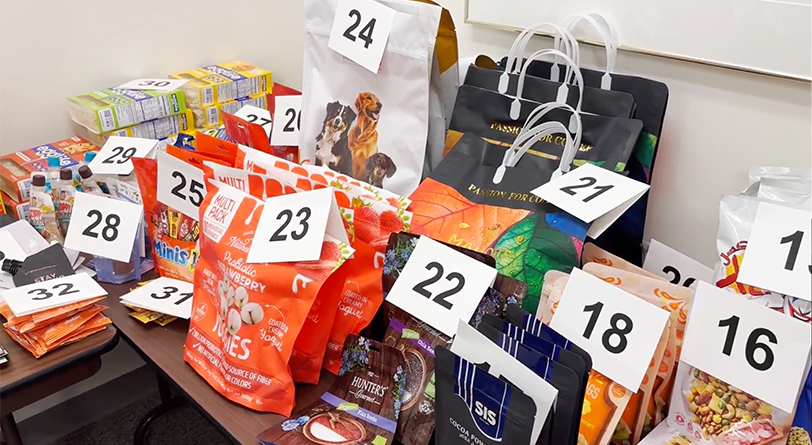
Over two days in November at the Flexible Packaging Association’s (FPA) Annapolis headquarters, an independent panel of industry experts assessed the best packaging offerings of the flexible packaging industry. A meeting room lined with samples showcased the packages that push the limits of science and technology to meet the rising demands of sophisticated brand owners and consumers.
The 2026 Flexible Packaging Achievement Awards Competition marks the 70th anniversary of a program that highlights and recognizes industry excellence. Launched only five years after FPA’s founding, the awards provide a platform to showcase manufacturers’ accomplishments. The 2026 competition judged entries in six categories—Expanding the Use of Flexible Packaging, Technical Innovation, Sustainability, Printing, Shelf Impact, and Packaging Excellence.
Many contestants entered their packages in multiple categories. Judges had the discretion to consider packaging in categories the entrants didn’t specify or to disqualify the occasional entry that fell short of demonstrating its value, or that failed to count as flexible.
The entries were judged by Fred Crowe, managing partner at Crowe and Associates LLC; Lisa McTigue Pierce, executive editor at Packaging Digest; and Dr. Yoorae Noh, assistant professor at the Michigan State University School of Packaging. Together, they huddled over binders filled with applications from 114 contenders.
A package could lose points for a slight misstep. For one entry, judges agreed that a unique, shimmering metalized polyethylene package lived up to its claims of being eye-catching, but Pierce noticed the lack of metalization on the logo.
“The logo is one of the flattest things on this package, so from a branding point of view, I think they missed the boat,” she said.
Judges brought their technical, regulatory, and design expertise to the table.
Claims of post-consumer recycled (PCR) content had to align with domestic and international regulatory and systemic realities. Packages feasibly incorporating PCR and sporting How2Recycle designations could score well, but the judges themselves had to tread a fine line in an atmosphere where extended producer responsibility (EPR) regulations and the science of recycling remain in flux.
“So much research still needs to be done on PCR content and how it affects material streams,” Noh said. Some owners are comfortable with the current industry standard of 30% PCR content, she added, but those in food are “struggling with barrier requirements for recyclability and recycled content.”
Experiential Judging
While entries were scored across six primary categories, the judges used their time with each to assess the overall experience the packages delivered. Hands-on interaction with the packaging sometimes provided revelations that the descriptions did not.
Judges used all their senses. They felt for “that tactile, pick-me-up feeling,” in the words of Pierce. They tore v-notches, sniffed and tasted products for freshness, and eyed the printing quality of package interiors. As the group marveled over a cap’s clever design, Pierce said, “I’m so glad I opened this.”
Cellphones came out to scan and test a QR code. A package described as soluble went into a tub of water, and it dissolved in 10 seconds.
Although customs regulations prevented international entries from containing food, many domestic entries held the snacks and goods they were designed for. One entry went into a microwave to test the heated product’s interaction with the package. Another got squeezed to test the product’s dispensability.
Pierce popped a candy into her mouth and pronounced it fresh and crunchy.
A carryout pouch received rave reviews for its vibrant color and reusability.
“It looks like a shopping bag,” marveled Pierce when Dani Diehlmann, FPA vice president, communications, placed it on the table.
“I would absolutely reuse that as a tote bag,” responded Diehlmann.
Passing the Test
Judges quickly noticed discrepancies between the packaging descriptions and the actual production and performance.
“They tout it as being plastic-free, but it is identified as a bio-polymer,” Pierce said of one entry.
“Those are plastics,” said Noh.
A lack of details explaining the printing processes, materials, sustainability claims, and other key factors used in design and production would knock points off many entries. If a package was claimed to extend shelf life, use a higher percentage of recycled content, or utilize fewer inks, the judges wanted to see the data backing the claims.
Judges asked a variety of questions—whether a window benefited the overall package, whether there was too much material for the product, whether the entry was just a new product in an old container, or represented a true breakthrough.
Some questions warranted a call to the manufacturer for clarification. One entry’s superlatives about its PCR content sparked a long discussion about how it could be accomplished.
Preparing for the Future
After hours of scrutinizing packages over two days, the judges turned to choosing the winners.
High scorers in each category returned to the table for potential Gold and Silver Awards—multiple winners were possible in each—and an International Gold and Silver. Some entries scrutinized early in the process got a second look in comparison to later packages.
Discussion drilled deeply into sealants, the effectiveness of interactions with rigid elements, the complexity or simplicity of production, and the enhancement of the consumer experience.
In most cases, the packages earning gold won for innovation and creativity—a new process, application, or design that showed significant progress in flexible packaging.
The silver winners were also progressive but tended to be well-made packages that revised or expanded the uses of known processes or materials. Differentiation earned higher rankings for shelf-impact winners. For one package, a cloudy window made the difference between gold and silver.
A unanimous judgment earned an easy gold for a package that delivered on its solubility claims, while another gold went to a recyclable, high recycled content, and bio-based package positioned to give the growing e-commerce segment a sustainable jolt.
Some leading entries won in multiple categories, while others shifted categories as they were compared. A snack originally considered under printing moved to shelf impact for, as Crowe noted, its intent to stand out from the crowd.
Winners will be announced at the FPA Annual Meeting, March 18-20, in Orlando, Florida, and judges will be seen in a video explaining their rationale. Next year, lessons learned will inform updates to the awards application, potentially adding new categories or requesting details on printing processes to support the packages’ sustainability and improvement claims. FPA will also publish the “2026 Flexible Packaging Achievement Awards & Innovation Showcase” to spotlight the winning entries and all submissions.
M. Diane McCormick is a writer based in Pennsylvania.