Collaborative Efforts Advance Flexible Film Recycling in California
Collaboration—not just end markets—is driving California’s next phase of flexible film recycling

At the FPA FlexForward® Conference in November, during a panel discussion on the future of flexible packaging recycling in California, leaders from across the value chain agreed that the industry’s response will depend on a systemic overhaul. They were clear: Without viable, scalable end markets, flexible film recycling will not succeed in California, no matter how ambitious the policy or well-intentioned the collection strategy.
That insight remains foundational.
But as California moves deeper into implementing SB 54—the states’ landmark extended producer responsibility law—a second truth is becoming just as important: end markets alone do not create effective film and flexible packaging recycling systems, collaboration does.
What is unfolding now in California is not the execution of a predetermined blueprint, but an iterative process of collective problem-solving that recognizes the complexity of flexible films and flexible packaging and the diversity of efforts and organizations seeking to meet these goals.
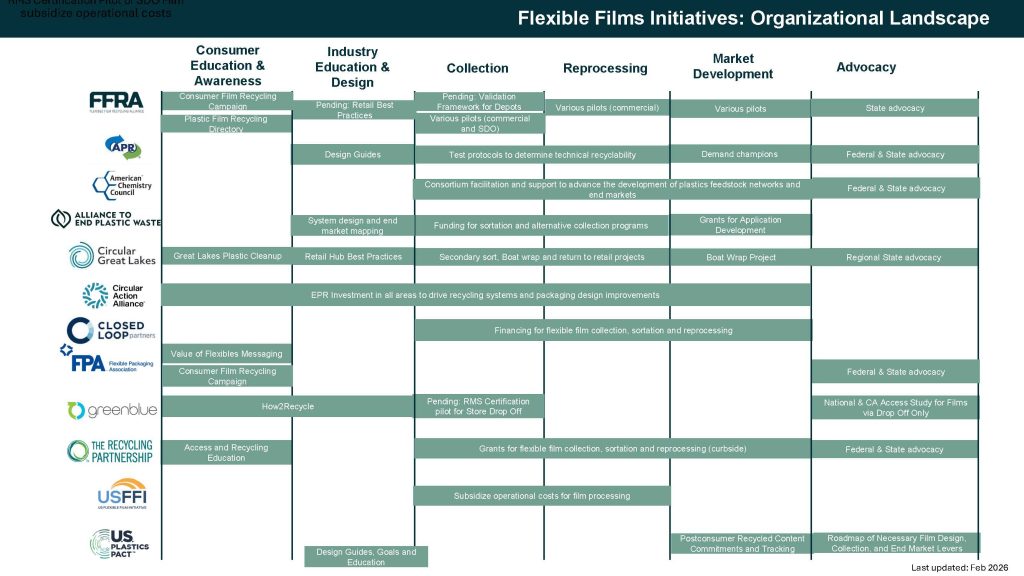
A collaborative of peer organizations working on flexible film and flexible packaging recycling, convened in January 2025 by the Flexible Film Recycling Alliance (FFRA), is working together to help map their independent efforts on film recycling, share insights from their efforts, and coordinate resources to reduce the learning curve and scale change.
In doing so, they seek to demonstrate how these collective efforts can demonstrate progress toward California’s legislated goals for recycling. This group refers to themselves as the Peer Collaborative, and is made up of staff from several organizations, including FFRA, the Flexible Packaging Association (FPA), The Recycling Partnership (TRP), Circular Action Alliance (CAA), the American Chemistry Council (ACC), the Alliance to End Plastics Waste (AEPW) and the U.S. Flexible Film Initiative (USFFI).
From Linear Assumptions to Systems Thinking
For years, flexible film recycling has been discussed as a linear challenge: improve collection, upgrade sorting technologies, and secure end markets. SB 54 disrupts that simplicity. The legislative timelines, performance requirements, and accountability mechanisms force stakeholders to confront the reality that these elements are interdependent—and that progress in one area cannot be sustained without movement in the others.
In response, brands, recyclers, retailers, and policy organizations are increasingly aligning around a shared understanding: progress will come through sequenced experimentation, not single-point solutions. The question has shifted from “What is the right model?” to “What can we test now, learn from quickly, and improve together?”
Data as a Starting Point, Not an Answer
One of the most consequential cooperative steps from the Peer Collaborative has been agreement on the need for harmonized baseline data. Data on flexible film and flexible packaging generation and recycling, resin types, collection sources, emerging recycling technologies, and related topics are fragmented. This has resulted in conflicting estimates of generation, capture, yield, and true recycling outcomes. Rather than debating whose numbers are “right,” stakeholders are aligning around shared principles for data scope, verification, and methodology.
This is less about short-term precision and more about long-term credibility. By establishing a common starting point, the system gains the ability to track improvement, adjust assumptions, and make informed decisions as pilots generate new insights. In this way, data becomes a living input to system design, helping keep all of us on the same metrics toward progress.
Pilots as Learning Infrastructure
The next iteration of film and flexible packaging recycling in California is being shaped through pilots that are intentionally designed to answer hard questions. How does bale quality change with different collection methods? What volumes are realistically achievable in commercial versus residential settings? Where do costs and contamination become limiting factors?
Multiple pilots, led by various groups, will allow each organization to focus on its own priorities while ensuring we can share lessons learned across the full value chain. Seen as “learning infrastructure,” each pilot feeds information back into system planning, helping stakeholders understand which scales, sectors, and approaches are most effective, and where collaboration or policy flexibility may be needed to unlock progress.
Importantly, these efforts recognize that interim solutions matter. Non-food applications, transitional markets, and hybrid collection pathways may not represent the final vision for flexible films—but they can create momentum, stabilize material flows, and reduce risk while longer-term markets mature.
Iteration Is the Strategy
If end markets decide whether flexible film and flexible packaging recycling is possible, collaboration decides whether it will stand the test of time. The Peer Collaborative efforts to demonstrate progress under SB 54 show that progress does not come from waiting for all conditions to be perfect. It comes from aligning around shared goals, building off our individual organizational strengths, testing assumptions in real systems, and committing ourselves to improve and learn together.
Kurt Kurzawa is senior director of sustainability and packaging at the Plastics Industry Association (PLASTICS), which created the Flexible Film Recycling Alliance (FFRA) in 2024.