
FPA Advocacy Overview
Efforts elevated for 2026 elections
As the U.S. prepares for midterm elections this fall, leaders at the Flexible Packaging Association (FPA) have been paving the way for the flexible packaging industry to have a stronger voice—not just during campaign season but all year long.
Over the past year, the association has continued to build its advocacy and public policy engagement. It created a working group focused on tariffs, one of the dominant economic issues under the Trump administration. It formed a new Government Affairs Committee (GAC) to develop positions on legislative matters critical to the industry. These steps build on the momentum generated by FPA’s political action committee (PAC)—FlexPAC®—launched in 2024.
The goals are to foster a united approach, inspire greater member engagement, and develop consistent industry messaging, according to Dan Felton, FPA’s president and CEO.
“I want FPA to be the subject matter expert,” Felton says. “When something comes up about flexible packaging, I want people to reach out to us first, whether it is the media or elected officials or other policymakers.”
‘Help the Greater Whole’
FPA’s government affairs function began taking shape under former President and CEO Alison Keane. She hired lobbyists at the state and federal levels and added the association’s first director of what was then called government relations, Felton says.
Felton, who succeeded Keane in November 2024, says he came on board with a goal of expanding on what his predecessor started.
Among his first steps was to disband FPA’s Circularity Committee, which had been functioning as a de facto government affairs body, and replace it with the GAC. One of the new committee’s chief functions is to craft formal positions on myriad issues facing flexible packaging companies, including the rise of state laws on extended producer responsibility (EPR).
“Over the years, the association has engaged on issues like EPR and labeling and recycled content,” Felton says. “But the reality is we didn’t have a lot of formal public policy positions on those issues.”
The lack became apparent when federal and state lobbyists came to the association and asked how they should approach a particular bill, Felton says. Should they support it? Oppose it? Stay neutral?
The association would have to go back and ask members each time something came up, Felton says. But once the GAC adopts a framework for a particular issue, the process can be more streamlined.
The committee’s first framework is on EPR, an issue that FPA has been studying for more than five years. In that time, seven states have adopted EPR laws, making it a subject worth revisiting, Felton says.
The laws, many of which are still in their infancy, typically require brands and packaging manufacturers to do more to collect and recycle their products.
“Anything we develop in EPR is probably going to be fairly fluid,” Felton says. “Our members might agree on something, but then two years later, after these laws have been up and running, something else comes up, and we say, ‘Hey, it might be good if this was or was not in the next law that gets enacted.’ ”
The guidance could come in handy if Congress begins debating a national EPR law, Felton adds.
The EPR framework is expected to be followed this year by frameworks on labeling, recycled content, and advanced recycling, Felton says.
“Generally, we are already saying that we support advanced recycling,” he says. “But the devil’s in the details. That is a good example where we would benefit from having a policy that says, ‘This is what we support, and this is what we do not support.’”
Other work the GAC may undertake includes reviewing and commenting on proposed regulations, where appropriate, according to Emily Williams, who chairs the committee. She is the sustainability and innovation partnerships leader at TC Transcontinental Packaging.
Williams also sees the committee playing a crucial role in connecting industry executives with policy and advocacy experts, helping them be more effective in policy discussions, whether that entails meeting with members of Congress in their offices or hosting lawmakers at flexible packaging facilities.
“Every company may have some of its own particular strategies when it comes to advocacy and policy that pertains to them,” she says. “But what we’re doing is trying to help the greater whole and lift the industry as a whole.”
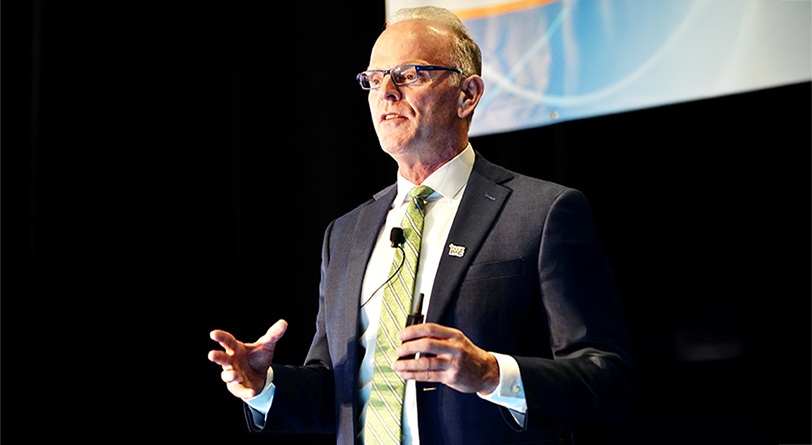
Dan Felton, president and CEO of FPA, gives a presentation to FPA members during the 2025 FlexForward® Conference held last November. Advocacy is a key pillar of FPA’s mission.
One Powerful Voice
As it works through various policies, the GAC is expected to work more closely with other FPA committees, particularly the Environmental, Health, and Safety (EHS) Committee.
The alignment will ensure FPA committees are not sending conflicting messages in response to regulatory and legislative proposals, says Kyla Fisher, the association’s director of regulatory affairs and sustainability.
“Harmonization allows us to speak with a more coherent, but also a more powerful, voice,” Fisher says.
The results are positive for the industry and the environment, says Cindy Haven, EHS director at ProAmpac and co-chair of FPA’s EHS Committee. “Any time we can advocate to impact proposed rulemakings that may impact us in a way that benefits our business while also benefiting the environment, it is a win on both sides,” Haven says.
Issues before the EHS Committee include workplace safety regulations, such as lockout/tagout procedures, Fisher says. Existing rules do not account for the capabilities of today’s automated technologies, for example.
“It is a hindrance to industry and employee safety,” says Norman Enix, EHS director at PPC Flex and co-chair of FPA’s EHS Committee.
Enix, who worked previously in the sleep products industry, has seen firsthand how companies can benefit from greater involvement in the legislative and regulatory process.
Mattress manufacturers, for example, faced significant pressure to recycle their products, and states began developing their own programs, he says. Worried about a hodgepodge of state laws, the International Sleep Products Association created its own national program for states to adopt. The key to success was getting the entire industry behind the effort.
“It has not been adopted by every state, but it has been adopted by California, Connecticut, and Minnesota, the states that are typically at the forefront of these regulations,” Enix says, noting a similar pattern is occurring with package recycling.
“I think that is a good model for us to consider,” he says. “We are much better off if we can get people to agree to what we want to do versus us having to comply with 10 different things.”
Enix also views the EHS Committee as a resource for FPA members to share information on workplace safety trends and best practices.
“If we start benchmarking across the board with health and safety statistics, we could understand where our issues are and then take the next step to develop training programs,” he says. “It is a good approach that I have seen be successful in the past.”
A Different Scenario for Tariffs
FPA members also want a strong voice on tariffs, according to Felton.
Tariffs are not a new issue for the association. But in the past, the focus was relatively narrow—primarily on thin-gauge aluminum foil.
“It is now a totally different scenario because it is impacting everybody on nearly everything,” Felton says. “FPA members and board members would like us to be looking for more opportunities where we can present our concerns to decision-makers.”
To address the need, FPA created a tariff working group that meets regularly and receives semi-weekly updates on the issues. The association is also seeking examples of how tariffs are affecting the flexible packaging sector, for good or ill, Felton says.
Direct Involvement
In addition to strengthening connections on policy, FPA has been strengthening its connections to the people who set policy.
FlexPAC® is on track to raise more than $100,000, according to Kelly Knowles, a political adviser and consultant to the association with more than two decades of experience in politics.
“You do not typically see that level of success right out of the gate,” Knowles says. “Under Dan’s leadership at FPA, members have responded positively, very generously to the PAC, to elevating the industry’s political engagement.”
Over the last two years, the PAC has donated approximately $14,000 to congressional candidates from both major political parties. Activity is expected to ramp up ahead of this year’s midterm elections, which could determine control of the U.S. Senate and House.
Before making campaign contributions, the FlexPAC® board examines candidates’ voting records. It also looks at whether an FPA member has a facility in a candidate’s district or whether a candidate sits on a committee that handles issues relevant to the industry, Knowles says.
FlexPAC® helps organize opportunities to forge relationships with lawmakers through FPA’s FlexFly-Ins. These events bring FPA members to Washington, D.C., for meetings with congressional representatives and staff members on Capitol Hill.
“The FlexFly-In is a terrific opportunity to take your message, your company’s message, the industry’s message directly to policymakers,” Knowles says. “The FPA team does an exceptional job lobbying on behalf of the industry. But it really packs a punch when member executives take time out of their busy days running a business to come to Washington to cultivate relationships with congressional offices.”
Felton plans to expand that engagement at the state level, with a potential fly-in to Sacramento, California, where lawmakers and regulators are debating issues critical to flexible packaging. The state’s EPR statute is set to take effect in 2027. FPA took part in a similar fly-in to Albany, New York, in 2025.
Felton is also open to any ideas FPA members have to boost the association’s advocacy efforts. “You don’t have to be on a committee to bring us ideas,” he says. “My door is always open.”
Joel Berg is a writer and editor based in Pennsylvania.