EPR and Flexible Packaging
Building a circular future for the industry
The U.S. packaging industry is entering a defining period. Extended producer responsibility (EPR) programs are taking hold across multiple states, setting new expectations for how packaging is designed, collected, and recycled.
For flexible packaging manufacturers and producers who use the materials, this shift is both a challenge and an opportunity to lead.
With more than 25 years in recycling and packaging, I have seen what drives success and what causes failure.
Post-consumer film and flexible packaging have long been among the hardest materials to recover at scale. Today, EPR laws provide the structure and accountability to address this challenge in a coordinated way.
Circular Action Alliance (CAA), the U.S. producer responsibility organization (PRO) dedicated to implementing effective EPR laws for paper and packaging, was created to help producers implement EPR programs efficiently and consistently.
CAA’s role is to build and administer EPR programs in accordance with applicable laws and regulations, enabling stronger reverse supply chains and recycling systems. Ultimately, this means building a system that delivers what packaging manufacturers and producers have long sought: more high-quality post-consumer material moving into end markets for use in new products and packaging.
That clarity of roles matters deeply for flexible packaging, because solving for film requires a level of collaboration and harmonization that the U.S. system has never had before.
Where EPR Stands Today
Seven states have passed paper and packaging EPR laws.
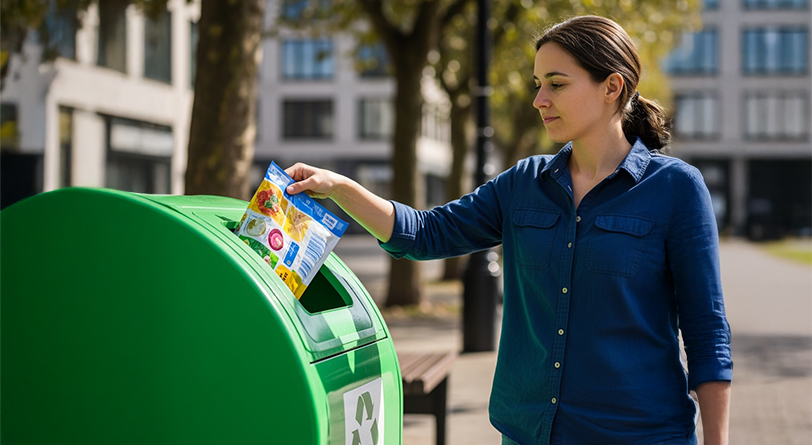
Oregon is the furthest along, with its program fully operational since July 2025. Producers have completed registration, reporting, and payment for the first program year and are preparing for 2026. CAA has launched its initial phase of system improvements, including the RecycleOn public drop-off network, which expands access for hard-to-recycle materials such as film and flexible packaging. More than 140 collection sites are scheduled by 2027, creating a consistent statewide system and generating data to inform future program design.
Colorado is finalizing program plan approval, and CAA is preparing infrastructure investments with communities and supplier contracting for a 2026 launch. California’s SB 54 regulations are under final review. Maine is completing rulemaking, and Minnesota, Maryland, and Washington have begun creating their rules.
Each state includes flexible packaging in its covered materials list, but approaches differ. Oregon emphasizes public collection sites. Colorado focuses on end-market development through post-consumer recycled (PCR) content mandates. California sets the most ambitious recycling targets: Film and flexible packaging must achieve a 30% recycling rate by January 1, 2028, and 65% by 2032.

Flexible Packaging: The Unsolved Recycling Opportunity
Flexible packaging plays an essential role and delivers critical benefits to consumers. It is lightweight, efficient, and essential for protecting product integrity and extending shelf life. However, it also creates a challenge: Post-consumer films and flexibles remain among the most difficult materials to recycle at scale. Difficult does not mean impossible, but solving this problem requires alignment across the entire system.
Pre-consumer film recycling from manufacturing, retail, and distribution is well established. The real challenge lies with post-consumer flexible and film plastics. Most of the value chain is misaligned for these materials, from design through end markets. Packaging is often multilayer and multimaterial, making it hard to separate resins, inks, and additives for mechanical recycling into high-quality products. This pushes output into lower-value markets that challenge returns on investment.
Films are light and flimsy, creating problems for equipment at traditional materials recovery facilities (MRFs). Curbside systems either exclude them or capture them with high contamination, driving up costs and producing inconsistent, low-quality bales.
Dedicated film programs exist, but they rely on drop-off collection and narrow PE specifications, limiting scale and leaving most flexible packaging outside the system. Imported resin often undercuts domestic recycled resin, while demand for high-quality post-
consumer resin remains limited. These economic realities can stall progress long before technical pilots can evolve into stable end-market infrastructure.
In states where CAA operates as the PRO, we can begin closing these gaps. Eco-modulated fees can reward mono-material, MRF-compatible designs. Targeted investments can upgrade MRFs for better film capture. Funding alternative collection and robust drop-off systems will expand access. Supporting specialized secondary processing facilities will enable both mechanical and nonmechanical end markets to scale, narrowing the cost gap between recycled and virgin materials. These actions will encourage producers to work with converting partners to incorporate higher levels of PCR content, accelerating the shift toward true circularity.
Film and flexible recycling is solvable—but not overnight. Immediate steps are underway, yet achieving high-scale circularity takes time. Manufacturing capabilities must evolve; packaging designs must adapt; producers must validate new materials for safety performance, consumer acceptance, and MRFs; and end markets must build capacity. This is a long-term transformation, and CAA is committed to leading it with industry and supply chain partners.
Collaboration and Harmonization Are Key to Scaling
No single organization can solve flexible packaging recycling on its own. Shared accountability across producers, converters, recyclers, local governments, and policymakers is essential. EPR creates an opportunity that did not exist before: focused funding and coordinated action from producers to convene all stakeholders and align efforts toward measurable outcomes.
CAA is using this framework to bring together industry leaders, technical experts, and material-specific associations such as the Flexible Packaging Association (FPA). These partnerships provide the expertise and practical insights needed to design solutions that work in the real world.
Harmonization is critical to reducing complexity. Without alignment, producers face a patchwork of conflicting requirements that slows progress and increases costs. Consistent standards allow companies to prioritize design improvements, integrate recycled content, and invest in infrastructure with confidence.
Collaboration accelerates innovation. When one state identifies an effective approach, others can adopt it quickly. This knowledge-sharing, supported by EPR funding and coordinated governance, is the foundation for scaling solutions nationwide.
For flexible packaging, this period is about building solutions that reflect how materials move through today’s systems. Industry expertise will be critical. Organizations such as FPA help ensure decisions are grounded in technical reality and aligned with the needs of producers, collectors, converters, and end markets to succeed.
Looking Ahead
The next several years will define how the U.S. manages flexible packaging end-of-life solutions. Success must be measured by real progress and clear outcomes:
Expanded collection points for films and flexibles through curbside programs and alternative systems;
- Strong, transparent, and responsible end markets for mechanical and nonmechanical recycling;
- Reliable data to guide design and recovery strategies; and
- Consistent collaboration across the packaging value chain.
Packaging EPR programs in the U.S. are still in early rollout, but they are establishing the structure needed for planning and accountability.
For flexible packaging, this period is about building solutions that reflect how materials move through today’s systems. Industry expertise will be critical. Organizations such as FPA help ensure decisions are grounded in technical reality and aligned with the needs of producers, collectors, converters, and end markets to succeed.
CAA, on behalf of producers, can now bring recyclers, converters, end markets, local governments, and policymakers together under a shared framework.
This alignment enables practical solutions to scale and creates the foundation for a recovery system that works for every material, including flexible packaging. Achieving this vision requires transparency, consistency, and trust.
When the value chain acts collectively, flexible packaging will lead to the building of a circular economy.
Jeff Fielkow is CEO at Circular Action Alliance.