Motivating People to Recycle Flexibles
New study offers guidance on increasing recycling rates for flexible packaging
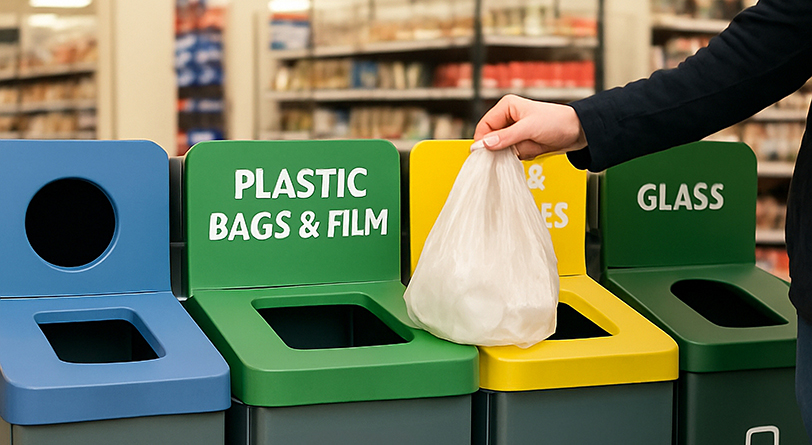
When it comes to recycling flexible packaging, there are four kinds of people: those who are committed to the cause; those who are motivated and could be persuaded to do more; those who are thoughtful but would need a lot of convincing to pick up their pace; and those who have no interest in doing it at all.
So, when it comes to efforts to increase recycling rates for flexible films, it would be best to focus messaging on just about everyone but the group of naysayers. That is one of the conclusions of an in-depth report from ERM Shelton, a consulting firm hired by the Flexible Film Recycling Alliance (FFRA) to conduct an analysis of consumers’ recycling habits. Founded in 2024 by the Plastics Industry Association (PLASTICS), FFRA seeks ways to improve the recycling of flexible film products by working to accelerate recycling rates, access, and education. The ERM Shelton report, which was co- sponsored by the Flexible Packaging Association (FPA), offers insights into boosting packaging and film recycling, particularly in the states that have adopted extended producer responsibility (EPR) laws.
“The FFRA/FPA Flexible Film Recycling Survey” followed previous research done by FFRA. In December 2024, FFRA surveyed California consumers, and the results helped the organization understand that there is a knowledge gap among consumers around flexible films, says Kurt Kurzawa, senior director of sustainability and packaging at PLASTICS.
“We wanted to leverage ERM Shelton’s expertise on how to bridge that knowledge gap through specific language of how we can drive people to recycle more flexibles,” Kurzawa says. The ERM Shelton study focused on states adopting EPR laws because of their mandates and recycling targets. “Not a lot of people understand that flexible films are one of the lowest carbon-impact products you can use in this space. It has high utility. It prevents diseases if you are using it for food contact. We wanted to focus on those states to get people to recycle more, to show that there is actually recycling being done, and to keep these products in the marketplace based on their high utility.”
The research “offers a roadmap to success” for creating messaging to significantly increase recycling rates, Kurzawa says, adding that nearly 90% of Californians live within three miles of a store drop-off location.
“If we want to move flexible film recycling forward, we need to be specific in how we address and talk about flexibles—and then how does that resonate with consumers to make sure we can drive action from them,” he explains. As the messaging takes hold, it can be shared among stakeholders along the value chain, Kurzawa and others say. “It’s about harmonizing our messaging and then making sure that we have a voice that resonates with consumers. At the end of the day, we want flexible films to be recycled at a much higher rate than they are now.”
A Detailed Analysis

ERM Shelton—whose slogan is “We’ve been doing sustainability communications since before there was such a thing as sustainability communications”—has known for a long time that the recycling rates nationwide are dismal and that many people have given up on their hometown recycling programs, says Suzanne Shelton, founder of the Shelton Group and now senior partner with ERM Shelton.
For nearly 20 years, Shelton’s company has surveyed people twice a year about their sustainability habits to determine what products they prefer and has turned those insights into messages and campaigns that will change their behaviors, shift their perceptions, and drive sales, Shelton asserts.
“Packaging has been a key piece of that research for the last 10 years,” Shelton says. “Not surprisingly, we have seen over the last 10 years that people think they are more awesome recyclers than they are. They assume that they are recycling everything when they are not.” When it comes to plastics, people routinely do not understand the numbers behind the chasing arrow symbols, she says as an example.
“They don’t know what items to put where, what goes into the curbside bin, or what has to be dropped off,” says Shelton, who gave a presentation on the report at the FPA 2025 FlexForward® Conference held in New Orleans last November. The report offers FPA members and others a guide to improving communication with consumers, while also bolstering the positive aspects of flexible films and packaging.
The need to do so is becoming critical, observers say.
The seven states that have adopted EPR so far have been rolling out various deadlines for their programs, including targets for companies to start using more post-consumer recycled (PCR) materials in their products. One long-known problem is that PCR supply doesn’t meet current demand, let alone the intense demand that new mandates will create.
It will be up to the producer responsibility organizations (PRO) of each EPR program to oversee the systems to capture materials before they go into landfills, financing those systems through fees paid by the producers of waste. The more consumers are educated about EPR—and persuaded to recycle more—the higher the recycling rates will rise to meet the new goals.
“In 10 years, we are supposed to go to 60%–65% recycling for plastics. How is that going to happen if we don’t understand what is in the way of consumers recycling their plastics today?” Shelton asks. Although there are some exceptions, people should not put flexibles at curbside. They have to voluntarily take materials to a drop-off location. And a lot of people have given up because they don’t trust that recycling works. “This body of work was [produced] specifically to understand what is in the way of recycling flexibles, what messages would get people past it, and how many people could be potentially motivated to do the right behavior.”
In the study, people were asked to provide details about their recycling habits. Some were given tools to record their actions and asked to complete various challenges set by the researchers, Shelton says.
“It almost looks like a social media app, and over the course of a week, we engage with them. We give them different challenges. We ask for videos. We ask for commentary,” she says. “We let them be self-observers responding to our prompts. That allows us to learn something about the mental model so that we can craft messaging.”
The results showed that 70% of people said they always recycle flexible films. “We know that is not true,” she says. “We know only about 2% of flexibles are getting recycled. People often think they are better recyclers than they actually are.”
Another key finding was that people often don’t know what a flexible is, which goes to the core of the messaging issue.
“That is step one. They have to understand what it is,” she says. About half the people also said they recycle flexibles in their curbside bins, but most recycling systems do not accept flexibles curbside. That leads to “Step 2,” which is, “they’re doing it wrong.”
The researchers also know that many people are earnestly trying to recycle and to do it correctly. From that, the researchers developed the four kinds of people categories—Dependable Do-Gooders; Motivated Moveables; Thoughtful Triers; and Neglectful Naysayers (see sidebar below).
About 97% of Dependable Do-Gooders can identify at least one flexible film, says Susannah Enkema, vice president of research and insights at ERM Shelton.
“The urgency message lets us tap into the general concern that everybody has around plastics.” —Suzanne Shelton, founder of the Shelton Group and now senior partner with ERM Shelton
“This is a really savvy group from that standpoint,” Enkema says. That group, along with the Motivated Moveables, are the “sweet spot” for messaging, she adds.
Other research also has shown that the majority of consumers are searching for greener products.
“They are looking for opportunities to do the right thing, and 82% of us feel moderately to very strongly responsible to change our daily choices to positively impact the environment,” Enkema adds. “This is an important stat. We think it sets the context for why we believe people will do the behavior needed to recycle flexible films at drop-off locations.”
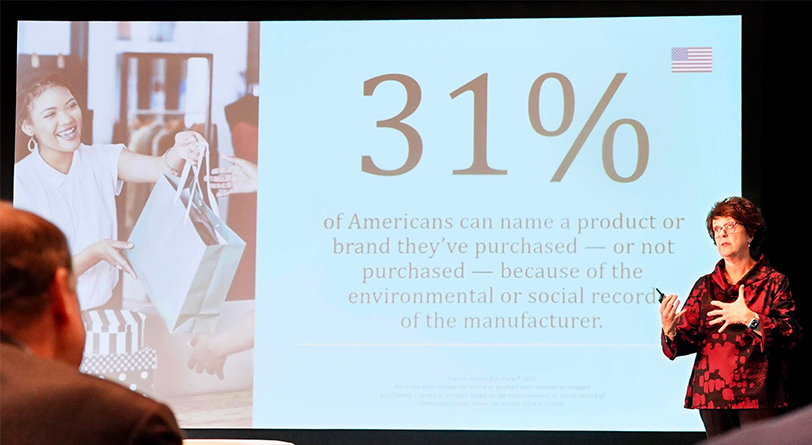
Suzanne Shelton highlights how environmental and social values influence purchasing decisions.
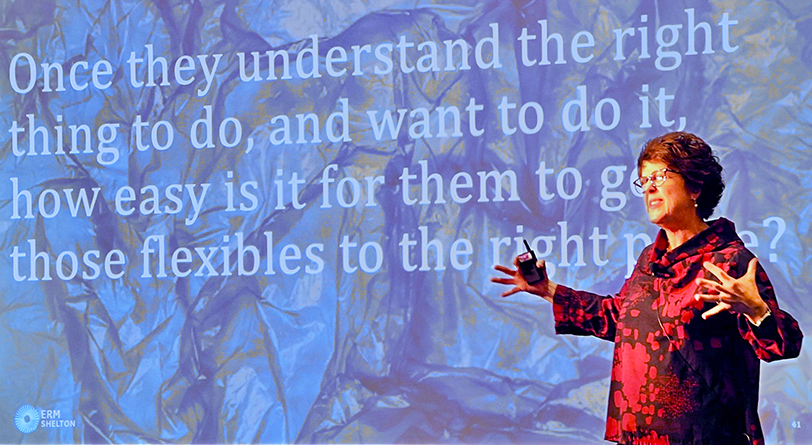
Suzanne Shelton explains that even motivated consumers need clear, simple access to recycle flexible packaging.
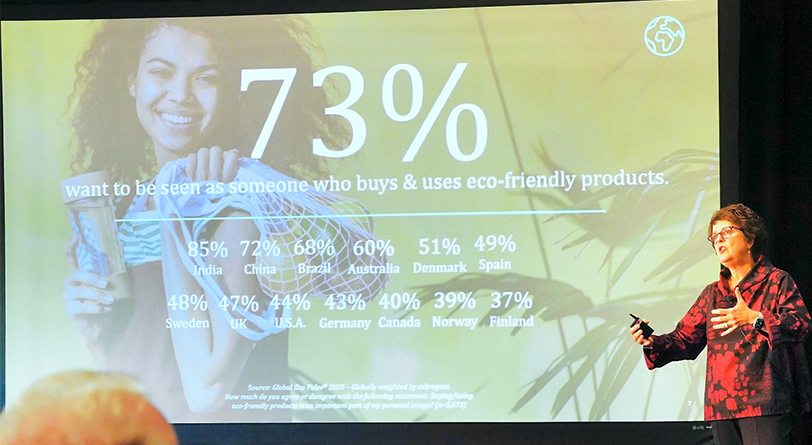
At the FlexForward® Conference, Suzanne Shelton presents new consumer insights on eco-friendly motivations.
Photos by Jeff Callen Photography.
Targeted Messaging
The initial messaging will target the first two groups because they will likely respond the best, rapidly increasing recycling rates, Shelton says.
“Something we have seen in our own data—and that we saw show up here, too—is that the more people believe the recycling system actually works, the more earnest they will be about doing it,” she says. Currently, however, the messaging isn’t clear. “If they do not believe it is going to get recycled, they are not going to make the effort.”
Kurzawa points out that FFRA and plasticfilmrecycling.org—the online directory that consumers can use to determine where to take their flexibles—are working on a third-party verification standard to help build assurance among consumers that flexibles are being recycled. “This will launch in early 2026 as part of our directory 2.0,” he adds.
In preliminary tests, the messaging frame that seems to work the best is one that calls for a sense of urgency—if people don’t recycle flexibles, the waste will end up in the wrong places, such as parks and waterways. That frame worked better than empowerment messages, which call on people to recycle more because they want to be part of the solution, Shelton says. Both frames will be used in the messaging campaigns because both were effective. Regardless, people are more likely to respond if collection bins are conveniently located throughout a community and with clear, simple instructions.
“The urgency message lets us tap into the general concern that everybody has around plastics,” Shelton says.
The next steps include creating pilot messaging programs that would be tried in a few communities before being rolled out to larger audiences. (California is a focus to ensure that the state’s high bar for recycling rates is met, Kurzawa points out.)
Shelton compares the test messaging to clinical trials in medicine “to see what works.” PROs could use the messages to further their mandates to increase recycling rates and to educate communities about the recycling initiatives required by EPR laws.
“We know who to target. We know what the message needs to be. We know what we have to do to get them to believe and to move into action,” Shelton says. “If we can increase collection rates by running a campaign in a few markets, then we hope to be able to take it more regional and then nationwide.”
Simple messages often work best. Although each community might have its own collection system and each state will develop its own infrastructure, consumers only need to know what to do with their materials, Shelton notes. For example, some communities might opt to support chemical or advanced recycling systems. Consumers don’t need to know about those technologies; rather, messaging should focus on how to dispose of their plastics.
“We don’t have to explain all of it to them,” she says.
“We want them to know whether to put their plastics in their curbside bin or bring them to another location. That is really it. We just need to tell them enough to get them to do it.”
A Vested Interest
For flexible packaging companies, they need to understand they have a vested interest in being proactive in communicating simple, direct messages to consumers, Shelton says. Although PROs, such as Circular Action Alliance (CAA), will be responsible for consumer education programs as part of administering EPR programs, brand owners, converters, and others involved in the supply chain must do more to ensure that messaging is consistent and easy to follow.
“When people believe the recycling system is working, then they believe companies are doing a better job of managing the end of life of their products,” Shelton says. “And then consumers feel better about the companies, which means they are more likely to buy their products.”
“If we are convincing people that squishy flexible thing they are buying is recyclable—but they have to bring it to the store and they see that it works—they are going to feel better about the brands that are in flexibles,” Shelton suggests. “This matters to the flexible packaging industry because brands want preference, brands want sales. So, the flexible industry needs to manage the public perception problem and turn it into a positive so that brands will use more flexibles. The brands already know that flexibles have the lowest environmental footprint.”
If the messaging convinces people that the systems work, they will think they are not wasting their time and that they are doing something positive for the environment.
“That’s all goodness for the brands,” Shelton says.
Thomas A. Barstow is senior editor of FlexPack VOICE®.
Sidebar: Types of People Who Recycle—Or Don’t
ERM Shelton’s study—“The FFRA/FPA Flexible Film Recycling Survey”—sought to understand people’s recycling habits with flexible films. Along the way, the researchers identified four distinct groups and determined the percentage of people who would be included in those groups so stakeholders could hone their messaging. Here is a closer look at those groups.
- Dependable Do-Gooders (13%): “They are motivated, but they are worried that their efforts might not matter,” says Suzanne Shelton, founder of the Shelton Group and now senior partner with ERM Shelton. “That doubt sometimes could keep them from making the effort, but they are more educated than the average bear about recycling and more willing to participate.”
- Motivated Moveables (28%): This group offers a sweet spot to increase recycling rates. They are sometimes confused about what is required—or what flexibles constitute—but they could be persuaded that their efforts are worthwhile, Shelton says.
- Thoughtful Triers (24%): This group might be willing to help but would need a lot of convincing. “We are not going to focus on them right away,” she adds.
- Neglectful Naysayers (25%): As the name suggests, these consumers would be nearly impossible to sway. “We are not going to focus on them because they are never going to do the behavior we need, and they probably do not do much recycling to begin with,” Shelton says.
When you look at the first two groups, strong potential exists to increase recycling rates of flexible packaging and films if messages target them and systems are in place to encourage their participation, Shelton says.
“We want to get all the dependable do-gooders because they are already doing a lot of the recycling behaviors— and going out of their way to do it,” Shelton says. “We are not going to get all those motivated moveables. We just need to reassure those who will do more that it is working—that their effort matters and they are making a difference.”
Recycling rates would increase dramatically from the current 2% for flexibles if the messaging could encourage about one-third of people to fully participate, she suggests.
“If we spend a little bit of money on some messaging, we can really move the needle,” Shelton says.